

Isandla
Embedding a just urban transition in informal settlements in policy and practice: Governance and funding priorities
Informal settlements are critical sites for advancing climate adaptation, mitigation, spatial justice, sustainable livelihoods, and resilience. Informed by engagements with key human settlements stakeholders between 2025 and 2026, this policy brief summarises an urban reform agenda focused on climate resilience, livelihoods, governance, and investment in informal settlement upgrading. It outlines priority reforms in governance, funding, and implementation, and sets out specific actions and institutional commitments required from - and committed to by - key national government stakeholders, namely the Department of Human Settlements, National Treasury, the Department of Cooperative Governance and Traditional Affairs (CoGTA), and Operation Vulindlela.
Policy Brief: Embedding a just urban transition in informal settlements

Informed by engagements with human settlements stakeholders between 2025 and 2026, this policy brief summarises an urban reform agenda focused on climate resilience, livelihoods, governance, and investment in informal settlement upgrading. It outlines priority reforms in governance, funding, and implementation, and sets out specific actions required from - and committed to by - key national government stakeholders.
Sustainable livelihoods, neighbourhood development and climate resilience
Current informal settlement upgrading efforts tend to prioritise physical infrastructure while giving limited attention to economic development and livelihoods. This weakens the potential of upgrading programmes to reduce poverty, build resilience, advance a sense of place, and create sustainable local economies. A just urban transition approach integrates climate mitigation, adaptation and economic resilience in neighbourhood development. Identifying five key priorities for embedding a climate-informed economic outlook into informal settlement upgrading, the knowledge brief specifically explores how public employment programmes like the Community Work Programme (CWP) can become instrumental in facilitating a just urban transition approach to informal settlement upgrading.
Embedding a just urban transition approach to informal settlements in policy and practice
In 2026, informed by the 2025 project 'Informal settlements as catalysts for a just urban transition', Isandla Institute and the Cities Support Programme of National Treasury convened a series of targeted roundtables to broaden engagement and deepen understanding of the implications of the just urban transition for informal settlements. This included roundtables with civil society organisations and municipalities (metros and secondary cities) respectively. The project continued its focus on sustainable livelihoods, economic development, and the role of public employment programmes in neighbourhood development - now specifically aimed at informing the repositioning of the Community Work Programme (CWP) as a just urban transition platform. Through strategic engagements with key government stakeholders, an urban reform agenda focused on climate resilience, livelihoods, governance, and investment in informal settlement upgrading was crafted. The project was supported by the UK Foreign, Commonwealth & Development Office (FCDO).
Sustainable Livelihoods, Neighbourhood Development and Climate Resilience
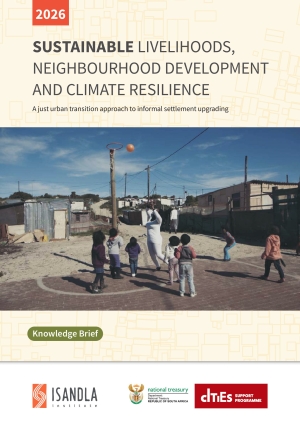
A just urban transition approach opens a new economic outlook towards informal settlement upgrading, one that combines livelihoods, resilience and neighbourhood development. In particular, public employment programmes focused on social value creation, such as the SEF and CWP, can be leveraged to drive a just urban transition approach to informal settlements.
Informal settlements as catalysts for a just urban transition
This synthesis document summarises the core arguments and conclusions of the project, noting that the reality of informal settlements should be understood as a national crisis, requiring extraordinary measures and targeted investment. Using a just urban transition frame, this crisis can become a vital opportunity, not only for informal settlement residents but also for the urban systems that these settlements are part of. It can result in upgrading processes that are inclusive and empowering, that build resilience and create livelihoods opportunities. It can transform spaces of neglect into vibrant, dignified, sustainable and safe spaces to live, play and work in. It can facilitate social and economic connections within neighbourhoods and within the city, contributing to the local economy and overall quality of life.
Governance and funding for informal settlement just transitions
Advancing a just urban transition approach to informal settlement upgrading means pursuing key development outcomes, such as resilience, sustainable livelihoods, dignity, social inclusion and urban integration. Critically, this requires a systems approach, rather than a project orientation, towards informal settlement upgrading and climate resilience. Yet, funding instruments are fragmented, not utilised effectively, and, frankly, insufficient. Climate finance and new economic value chains present new opportunities for investment in informal settlements, but to harness these possibilities and advance inclusive, outcome-oriented informal settlement upgrading as scale requires new capabilities, systems and governance arrangements based on co-governance and accountability.
Centring the local economy and livelihoods in informal settlement upgrading
In a context of high unemployment, informal settlements represent the failure of South Africa’s labour market. A just urban transition places significant emphasis on economic considerations as central to any form of (climate-informed) development. Place-based, place-making and circular economy approaches hold significant potential for foregrounding the economic dimensions and potential of informal settlement upgrading. Through the creation of social value, public employment programmes can play a critical role in the transformation of informal settlements into resilient, safe and liveable neighbourhoods, as lessons from the Social Employment Fund show.
Undoing the crises of vulnerability and spatial injustice: Prioritising informal settlements in the just urban transition
Since 1994, South Africa has witnessed exponential growth in informal settlements, currently housing about a quarter of households in urban areas. Informal settlements are particularly vulnerable to climate impacts, such as heat, flooding and storms. Climate adaptation and disaster relief, especially community-led initiatives, are really important, but to achieve systemic change, at scale, a fundamentally new approach to informal settlement upgrading is needed – one where innovation, targeted investment, capacity enhancement and community agency take centre stage.
Leaving a legacy: The Backyard Matters Project (2019-2025)
For the past 5 years, Isandla Institute and the Development Action Group (DAG) have partnered to create greater recognition of, and support for, the informal backyard housing sector in South Africa. The Backyard Matters Project engaged in enumeration, research, community engagement, dialogues, learning initiatives and advocacy to augment the collective understanding of backyard housing and its contribution to affordable housing, livelihoods and township economic development and to identify policy and programmatic interventions to support and improve this sector, in all its diversity and complexity. At the conclusion of the project, we asked various stakeholders in government, civil society and local communities to reflect on the project and its impact.