

Super User
What does a “just transition” mean for you?
Millions of people living in informal settlements experience high risks related to climate change. The land they live on can easily be flooded or collapse in mudslides. Low quality housing, made from zinc with not enough ventilation, is less able to resist high winds and can make heatwaves feel worse. Government must play its part in upgrading informal settlements to help reduce vulnerability and increase the resilience of communities to climate change. If you are interested in what the government’s proposed "just urban transition" means for people living in informal settlements, download our pamphlet here.
The project was funded by the Canada Fund for Local Initiatives (CFLI).
Co-creating a ‘just urban transition’ approach to informal settlement upgrading
In 2023 Isandla Institute has deepened its work on informal settlement upgrading through a project that seeks to understand what a “just urban transition” could mean in practice for informal settlement communities and municipalities. The need to address the climate crisis, particularly for those who live in informal settings, is urgent given that people who live in them often bear the brunt of recurring shocks, such as floods and droughts. Almost 20 years after its inception, a policy to incrementally upgrade informal settlements appears to a large degree stuck – resulting in little more than serviced sites in most cases where development is initiated. South Africa’s “just urban transition” strategy emphasises that upgrading informal settlements is key if cities are to decarbonise in a manner that can also address inequality and spatial injustice. Much hinges on the ability of local government to engage collaboratively with communities – something that has proved difficult to achieve in the past. In unpacking what this approach means for informal settlement residents, the project engages with a range of stakeholders, including informal settlement residents, government, urban policy experts, environmental organisations and civil society organisations working in informal settlements. From this, it aims to develop an engagement tool that government and community-based organisations will be able to use in a collaborative approach to upgrading aligned with principles of a “just transition”.
“The project was funded by the Canada Fund for Local Initiatives (CFLI).
SPRINT Learning Brief 2: Integrated Area-Based Violence Prevention Interventions
This is the second Learning Brief in a series of Learning Briefs produced by Isandla Institute under the Safer Places: Resilient Institutions and Neighbourhoods Together (SPRINT) Project. The Learning Brief is produced from the discussions at the second Learning Network session, hosted on 03 December 2020, focusing on What is integrated area-based violence prevention interventions (VPI) and examples of VPI practices. The brief is an introduction to integrated area-based violence prevention interventions (ABVPI), including the socio-ecological model and the principles of crime prevention through environmental design (CPTED). The brief outlines key policy frameworks that guide VPI work, including the National Development Plan, the White Paper on Safety and Security and the National Strategic Plan on Gender-based Violence and Femicide. The brief also outlines key challenges in VPI, including a lack of common understanding of what violence prevention is, the importance of addressing underlying root causes in VPI and the need for multi-sectoral approaches between stakeholders.
SPRINT Learning Brief 1: The impact of COVID-19 on safety, wellbeing, and vulnerability to crime and violence
This Learning Brief is part of a series of Learning Briefs produced by Isandla Institute under the Safer Places: Resilient Institutions and Neighbourhoods Together (SPRINT) Project. The Learning Brief is produced from discussions at the first Learning Network session, hosted on 05 November 2020, focusing on The impact of COVID-19 on safety, wellbeing, and vulnerability to crime and violence. The brief includes an overview of the SPRINT project, the nature of violence and crime in South Africa, and some reflections and lessons on the impact of, and response to, COVID-19 by Civil Society Organisations (CSOs). The COVID-19 pandemic has placed further strain on several strained services. One of the key messages of the brief is the importance of social cohesion and solidarity in addressing underlying causes for violence and crime, especially in the current context of anxiety, stress and uncertainty.
Advancing a co-production approach to upgrading informal settlements in South Africa: A Guide for Municipalities
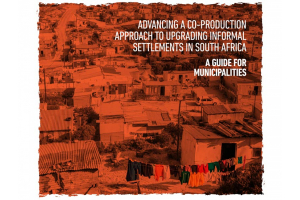
This guide navigates the various moments in the upgrading process that present opportunities for greater community participation and co-production. It identifies possibilities for co-production and the relationships between all actors in an upgrading project. The guide responds to the realities and constraints facing municipalities, and seeks to assist officials in creating the space and shifting the mind-set across all three spheres of government towards co-production in informal settlement upgrading.
Advancing a co-production approach to upgrading informal settlements in South Africa: A Guide for Municipalities
This guide navigates the various moments in the upgrading process that present opportunities for greater community participation and co-production. It identifies possibilities for co-production and the relationships between all actors in an upgrading project. The guide responds to the realities and constraints facing municipalities, and seeks to assist officials in creating the space and shifting the mind-set across all three spheres of government towards co-production in informal settlement upgrading.